
An in-depth look at the technology powering Drawize Academy’s real-time feedback system and how it helps artists to improve faster.
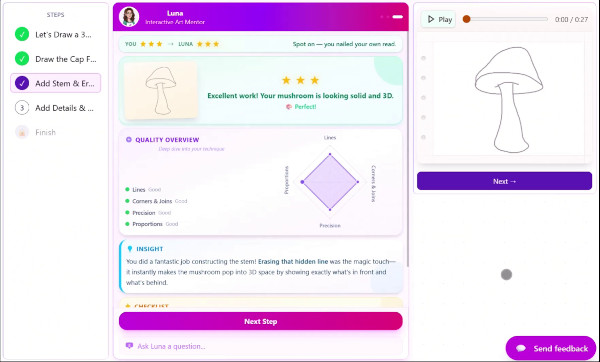
As soon as you press submit on your drawing on Drawize Academy, the system will within seconds start to understand what you where trying to learn, what you actually did, and how to help you improve on what you just did.
In this article, we’ll go over how the Pedagogical Engine works, how Drawize Academy differs from other AI art tools, and how a very simple loop of draw – scan – correct can actually turn out to be a really powerful learning experience.
Beyond Pixel Matching
One simple way to give feedback about drawings is to compare them to references and calculate a score by counting matching pixels. This approach fosters tracing instead of thinking, and penalizes styles very different from the reference. Furthermore, even perfect drawings of structure using a different line than in the reference can score very low.
Good art teachers are not concerned with the same metrics as these systems, for the reason that comparing drawing and reference is not the same as teaching drawing. Good art teachers care about whether or not you have grasped the spatial logic of a subject: perspective, proportion, form in space.
Drawize Academy supports the same viewpoint as your good art teacher. We are looking at what will matter most to your progress in learning to draw, not the matching of a printed screen shot.
Seeing Structure, Not Just Surface
Under the hood, our system is instructed to check structural elements that matter for foundational drawing:
- Proportions - Are the relationships between major parts consistent and believable?
- Perspective - Do lines that converge in a point actually converge? Is the horizon line correct?
- Form - Do shapes read as three-dimensional volumes rather than flat outlines?
- Alignment - Are key landmarks (eyes, joints, wheels) drifting or anchored where they should be?
- Overall construction - Does the drawing respect the underlying spatial logic of the lesson?

The Pedagogical Logic Layer
The analysis of your drawings is only half of the story. The other half is helping you with feedback that enables you to proceed to the next step. We refer to this as the Pedagogical Engine of Drawize Academy.
Each lesson step in Drawize Academy has a clear learning objective (e.g. place the horizon and the vanishing point of a scene correctly or use ellipses to describe cylinders convincingly). On submission, the system considers questions such as:
- Which part of the lesson did you already get right?
- Where is your structure drifting away from the target?
- What is the absolute simplest thing you could be told to fix this?
Instead of just "wrong" or "right", feedback might say:
"Your horizon line tilts upward on the right, although this exercise calls for a level view. Redraw it horizontally, keep the vanishing point on it, and aim the receding window edges toward that point."
That is formative feedback, which is specific, timely, and meant to be used to help improve your work in subsequent attempts.
Vision-Language Models Tuned for Teaching
Drawize Academy uses modern Vision-Language Models. We give those models lesson objectives and grading instructions for art education, so that their feedback addresses the drawing task. They can still miss or misread parts of a drawing.
🎯 See what you drew
Analyze the visual content of your drawing in detail.
📚 Know the lesson context
Use the exact step objective to filter what matters.
🧠 Apply art principles
Evaluate perspective, proportion, and form, not style.
💬 Explain clearly
Turn analysis into plain, actionable guidance.
Adaptive Difficulty and Scaffolding
One of the hardest things in teaching is to keep your student in the “sweet spot” of not being bored and not being overwhelmed. Our system tries to keep the feedback within these boundaries based on the level of the current lesson and on the student’s recent performance.
Complete beginners are focused on achieving the biggest successes possible such as getting the basic orientation of a drawing right or even just achieving reasonable proportions. Advanced students are focused on achieving feedback that is progressively more precise such as making the ellipses in a drawing more consistent, cleaning up the lines in a perspective grid drawing, or achieving more precise control over complex form drawings.
The authored lessons support the learner by starting with simpler tasks and introducing more demanding ones as the learner progresses. Luna provides feedback along the way.
Human-Centric and Ethical by Design
Luna was not created to replace artists and/or teachers. Her intention is to make available to a broader audience structural feedback that can support practice between lessons with artists or teachers.
- You make your drawings. You decide how to improve them. AI assists with feedback and even some preparations for lessons that you take.
- We focus on technique, not artistic taste or style.
- As you progress along the steps to learn drawing, we shall be measuring your progress against your own previous work, not that of your peers.
This may also help free up your time in the classroom, so that instead of checking whether the perspective lines are converging, you can focus on creative mentoring, concept feedback and encouraging your students.
The Draw → Scan → Correct Loop
The Draw → Scan → Correct Loop is the core of the Drawize Academy system and is also probably the simplest way to describe how it works.
- Draw your attempt for the current step.
- Scan or submit it to Drawize Academy.
- Read the specific feedback you receive.
- Correct your drawing or start another drawing to continue working on the step.
By cycling through Draw, Scan and Correct your practice remains focused and not merely repetitive.
Try It Yourself
The best way to see how our interactive feedback works is to try it out for yourself with a “Try It Yourself” skill check. Just draw a quick sketch for the first step of the skill check and submit it to Drawize Academy to read the specific and structural feedback given to you.
Our long-term vision is to power a “Pedagogical Marketplace” where educators can turn their passive online videos into fully interactive and superior courses. For now, we’re happy to power a single drawing and corresponding feedback for the next attempt to improve.

Tomislav Lombarovic
The Founder of Drawize Academy. Originally creator of the Drawize game, a simple online game which has served over 10 million players.