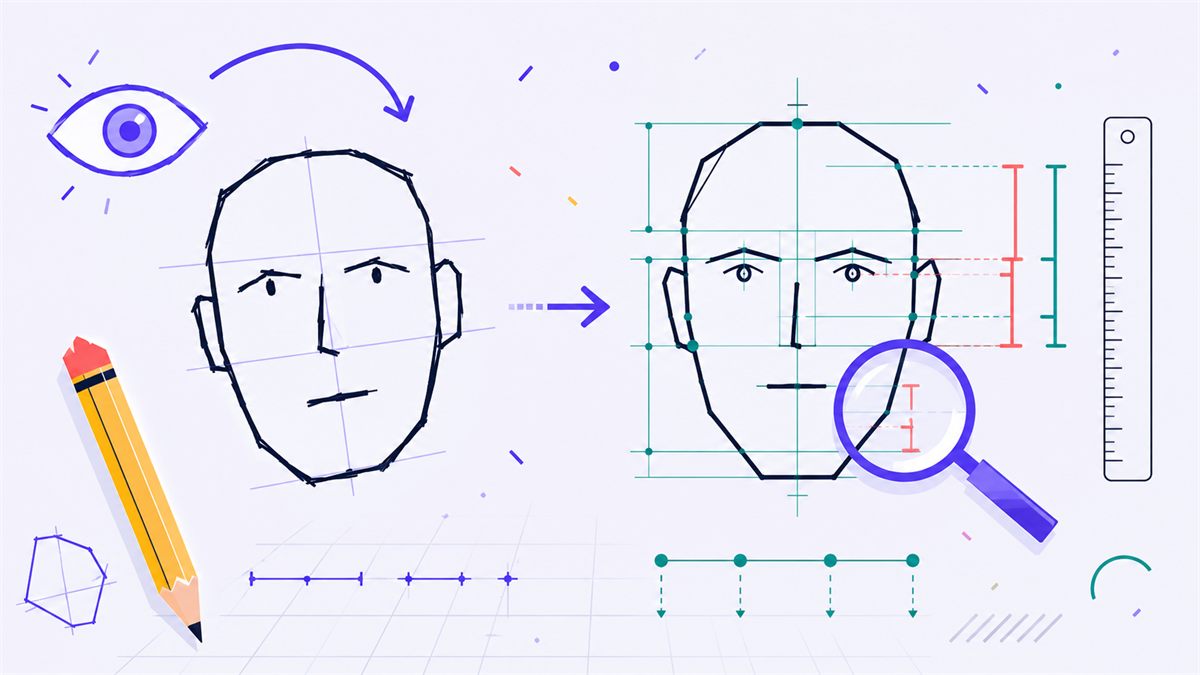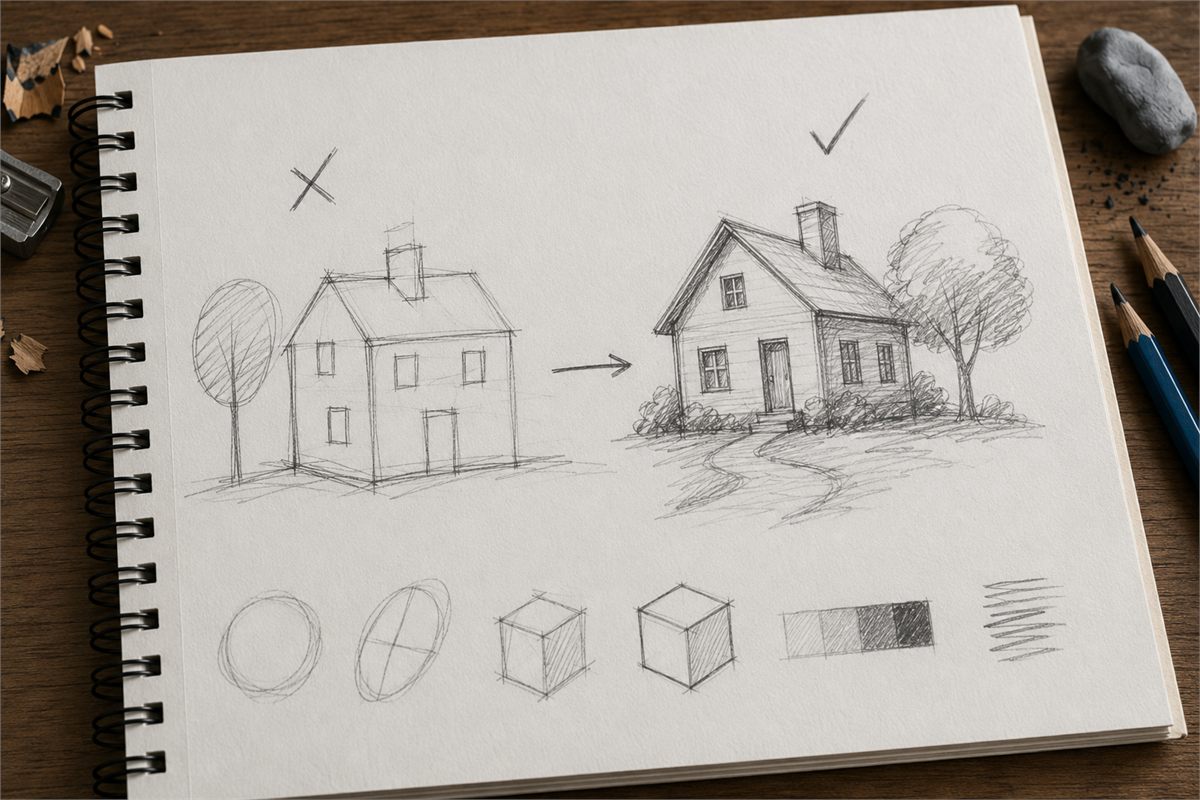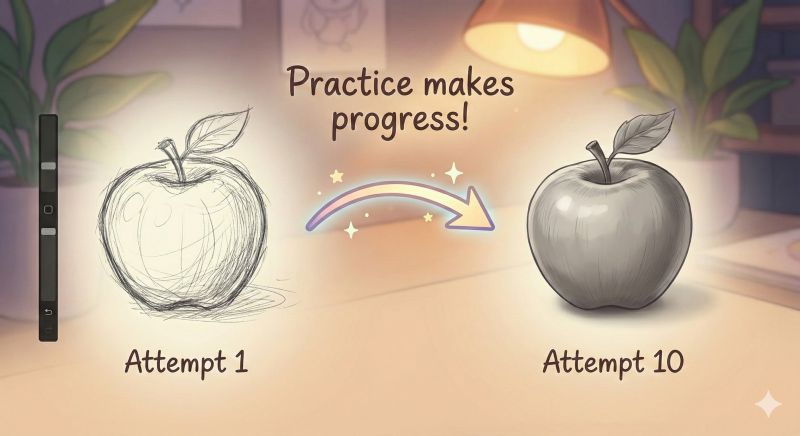

Learn how specific goals, deliberate practice and feedback can help you make use of drawing tutorials. See how Drawize Academy puts that practice into its lessons.
A well-known idea drawn from research is that it takes 10,000 hours to master a skill. That is not a universal threshold. The work of psychologist Anders Ericsson and his colleagues looked at the time spent on deliberate practice, not simply time spent doing an activity. How you use that time matters too.
Just practicing something over and over doesn’t make someone an expert. Self-taught artists can be lacking deliberate practice – even though they spend a lot of time practicing.
What Is Deliberate Practice?
Deliberate practice refers to structured training aimed at enhancing performance. It can encompass many hours of training but that alone does not account for mastery of a skill. Here are four characteristics of deliberate practice:
- 1Specific goals
“Practice drawing” is not the same as “draw boxes in two-point perspective with a fixed horizon for 15 minutes” (a specific goal for deliberate practice).
- 2Focused attention
It means concentrated, focused practice on a single skill, in isolation from other skills (e.g., you’re not watching another video while you’re practicing drawing).
- 3Immediate feedback
Know quickly whether you’re getting better, worse or staying the same and why.
- 4Repetition with refinement
Trying again with a specific adjustment in mind, rather than repeating the same mistakes over and over again.
Why Traditional Art Learning Falls Short
Think about a common path for self-taught artists:
- Search for a YouTube tutorial on drawing faces.
- Copy along with the instructor, step by step.
- Try to draw a face from imagination later.
- Notice that something feels off.
- Have no clear idea what went wrong and how to fix it.
- Open another tutorial and hope this one helps.
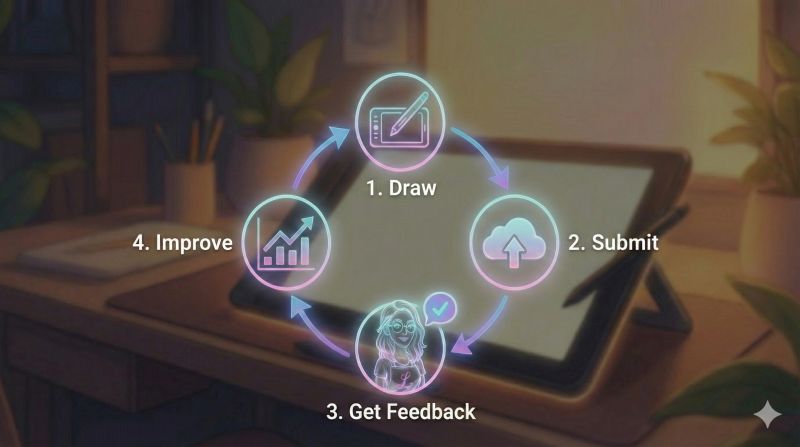
The missing piece in this cycle of skill development is immediate, targeted feedback. The artist can spend years practicing the same fundamental mistakes, becoming more confident but less accurate in their work, without ever realizing their error.
The Science Behind It
A few strands of research are especially relevant for artists:
- Deliberate practice research (Ericsson) emphasizes structured activities aimed at improvement, with feedback and repeated correction. The original studies were not a direct test of artists or of this drawing course.
- Studies on formative feedback (Hattie & Timperley) have found that feedback that is specific, timely and focused on individual aspects of performance has significant impact on learning outcomes as opposed to general compliments.
- Research has established a strong link between a person’s visual-spatial skills (for example, Wai, Lubinski, & Benbow, 2009) and their success in a range of STEM areas as well as design-related fields.
So, as you learn to draw, you also practice thinking about forms in space while you work towards focused goals, receive feedback and continue to make corrections. The research above does not establish that taking this course improves STEM outcomes.
How Drawize Academy Applies Deliberate Practice
As Drawize Academy is based on deliberate practice, every lesson consists of a sequence of steps, each with defined success criteria and corresponding feedback.
🎯 Specific Goals
As opposed to the broader goal of drawing complex scenes, each step in the lessons focuses on a specific concept that can be practiced in a short session. For example, you place three boxes in two-point perspective using a shared horizon line.
🧠 Focused Attention
Each step gives you a short task to focus on one aspect of drawing in detail. There is no time limit. Many aspects are involved in drawing such as shading, anatomy, perspective, and composition. However, we focus on one concept at a time.
⚡ Immediate Feedback
When you submit, the AI checks your drawing against the step criteria and offers feedback. Since the attempt was made recently, you still have it very fresh in your mind and can compare the suggestion with what you drew.
🔁 Repetition with Refinement
Each attempt at a new step does not have to be perfect. If on the first try you fail a step, it’s not failure – it’s part of your deliberate practice, and each new attempt is guided by precise feedback.
Staying in the Productive Zone
It’s sometimes said by educational psychologists that there is a learning ‘zone’ where the most learning takes place – i.e. the task is just about to exceed the learner’s ability to complete it alone but can be completed with guidance. Below that and the task is dull, above it and the task is too difficult and the learner may struggle to make progress.
To ensure you stay in the productive zone for your drawing skills, the academy employs the methodology of instructional scaffolding. As you learn to draw simple shapes like spheres, cylinders, and boxes, progressing to large simple compositions with clear horizons, in subsequent lessons you will practice drawing more complex volumes using more complex spatial logic.
Deliberate Practice and Access
Private tutoring is one route to structured, feedback-rich practice and it can be expensive. Access to that support can differ between students with resources to spend on coaching and those without.
By delivering an online feedback loop to students, Drawize Academy aims to make structured practice easier to access from different places. AI feedback can support that practice, but it is not a private tutor's review. Course access and sketch critique have their own purchase options and usage limits, shown before purchase.
What This Means for Your Art Journey
This isn’t about talent. It’s about the lack of a solid practice structure: clear goals, fast and constructive feedback, systematic repetition with adjustments that address the feedback.
Working smarter, not harder. The goal of Deliberate Practice is to improve quickly, even working in very short bursts of time. You can see a tangible amount of progress in a short period of time.
What does this look like built into a tool?
I described this process before, so it’s worth seeing it in action on a specific tool to see how hard it is to actually supply both feedback and discipline to practice yourself.
The box in perspective drill and the cylinder drill have full staged courses for building constructions to practice drawing in perspective. They start by building the construction with you one mark at a time while checking each mark as you draw it. The construction is then removed one support at a time until you are working on an empty sheet of paper. Deliberate practice is not repetition, but rather advancing in ability as long as you are practicing “just beyond your current ability” for the skill being practiced in the exercise. Thus you would not advance to the next exercise after a set number of drawings of each exercise, but rather when your measurement says you have reached a certain score for that exercise. And the feedback from the measurement (i.e. the score for your attempt at the skill being measured in the exercise) arrives in the same second as the attempt, which is not normally the case.
Start Practicing Deliberately
Take the first step today. Start a free lesson in Drawize Academy. Do a simple exercise and review the feedback to see how you can do it even better the next time. Start small today. Get a free critique of your latest sketch and find out what you need to practice first to improve your drawing skills.
This is how you practice deliberately and how you will reach artistic growth in the long run.

Tomislav Lombarovic
The Founder of Drawize Academy. Originally creator of the Drawize game, a simple online game which has served over 10 million players.