
Your drawings don’t look bad because you lack talent. Here are the 7 fixable reasons a drawing looks off, stiff, or flat – and a 5-question checklist to find out which one is yours.
You finish a drawing after hours of work, hold it at arm’s length, and immediately feel that something is wrong with it. You can’t quite point out where exactly it is, but the whole drawing looks wrong in a way that the reference photo or the tutorial you followed to complete the drawing didn’t. If you have ever been to the point of putting your sketchbook away for months because of such a feeling, then this article is for you.
First of all, my point is this: your drawings look bad for a reason. What looks wrong to you in your own drawings (even when they are great in other ways) is not a mystery or a failing. There is usually only one of a handful of possible causes for anything that looks wrong to you in your drawings. Many can be described clearly and worked on with practice. Learning to name what looks wrong gives you a place to start.
It's not talent, but rather a small list of skills that can be learned and mastered.
When beginners talk about not being able to draw, what they’re usually saying is that their drawings do not match the images they had of what they would make. But drawing is not one skill – it is many. A novice drawing can look off because a few skills need more practice, not because some unknown Talent is absent. And the good news about those simple skills is that they can be practiced individually. So rather than struggling to get better at everything, the beginner need only discover which of the simple skills needs attention and practice that. Here are the causes of poor novice drawings that we most commonly see – listed in roughly the order of most common to least.
Reason 1: Your proportions disagree with each other
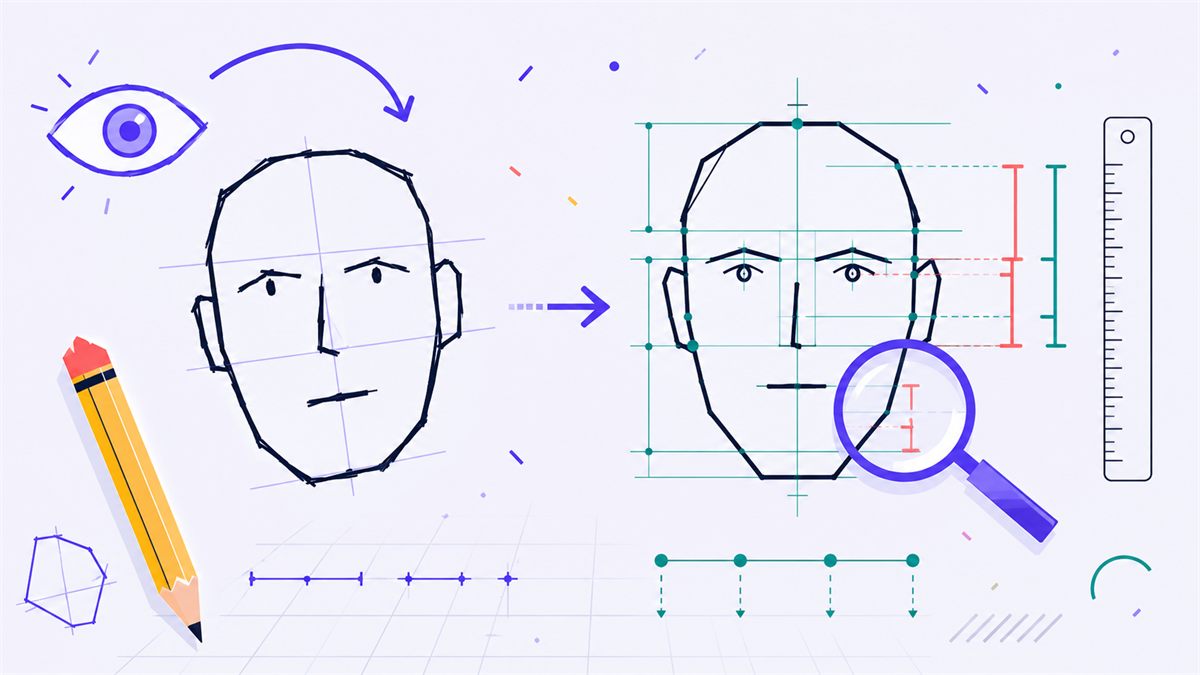
The brain is capable of judging proportion of shapes in a drawing with great accuracy. Often the error is not that one shape is too large, but rather that two parts of the figure have been drawn to different scales. This can make a drawing look strange and even give it the appearance of being “distorted” or “creepy”.
The fix: Before starting to add more detail to your drawing, set up the major masses first and then check them against each other. Start with the top half of the drawing and then work your way down to the bottom half. Compare the left side of the face to the right side and also check the overall width of the drawing from side to side. Flip your drawing over and compare it to the reference image or even just the mirror image of what you’ve already drawn. You can also upload your drawing and the reference image to Rate My Sketch and Luna can compare your drawing to the reference for you and suggest where its proportions drift. Check those suggestions against what you can see.
And interestingly enough, you can test your judgement for proportions for other things as well. Your estimate of the middle of an upright line may be higher or lower than it actually is. That is one proportion judgment you can measure separately from a whole drawing. You can test your own misjudgement with this free online exercise that involves marking the middles of 6 bars by eye: drawing-exercises/proportions. For a more comprehensive test of all the drawing skills listed above (and more), see the drawing-test online test of drawing skills. Both tests are free, unlimited and scored in your browser without AI.
Reason 2: Hesitant, stitched lines make everything look stiff
Take a good look at any line on your drawing that looks “scratchy” or “stiff” and bet your bottom dollar it is made up of 5 short lines. And guess what? Each of those short lines is drawn slowly and deliberately with your fingers. The lines wobble, crisscross, and change in weight suddenly. The average viewer can see that sort of nervous energy instantly, even from across the room.
The Fix: Make longer lines using movement from the shoulder and elbow. Draw these lines quickly and some of them may not fit perfectly. Remember that drawings with confident lines that are almost but not quite correct look far better than accurately drawn lines with hesitant edges. Practice single-stroke lines and ovals for 10 minutes a day to regain these skills in very short order.
Reason 3: Flat shading and a narrow value range
So long as every part of your drawing is shaded then it will appear unfinished or washed out if it consists mainly of light to medium grays. The problem may be that the tones do not separate the light-facing areas from the darker ones. To develop forms in this kind of shaded drawing, use differences in value that follow the intended light direction. A deliberately light or unshaded drawing can still work. The problem is one of value range.
The fix: before you do any shading to add depth to your drawing, determine where your darkest dark and lightest light will fall and strive to reach those values. A five-step value scale drawn in the corner of the page to reference while completing the rest of the drawing is an extremely simple but very powerful tool.
Reason 4: Corners and joins that don't quite connect
These are mistakes that are so fundamental that most people never even notice them. But if you draw a box with edges that don’t quite meet at the corners, lines that are supposed to meet can overshoot in an ‘X’ shape, or stop short and leave a gap. In such cases, even a simple box of drawing looks like firewood.
The fix: Practice this by slowing down for the last 5% of each stroke. Practice drawing simple closed shapes such as squares, triangles, and letters. See how you can make sure that the ends of neighboring strokes connect up so that there is no overshoot or gap.
Reason 5: Marks that don't land where you aimed
A fundamental skill which nobody wants to practice: drawing accurately. Your details may wander off from the shape they are supposed to define, or your lines might bulge in the middle on one side. Hatching may stray from the area you drew it in to define. Each of these inaccuracies causes the next to deviate from where you intended it to be.
The fix: ghosting. This simply means hovering the pencil along the intended path of the line you want to draw two or three times before finally tracing it for real. At first this can feel like a really daft thing to do. With practice, it can help you aim the lines more consistently.
Reason 6: You're drawing the symbol, not the thing
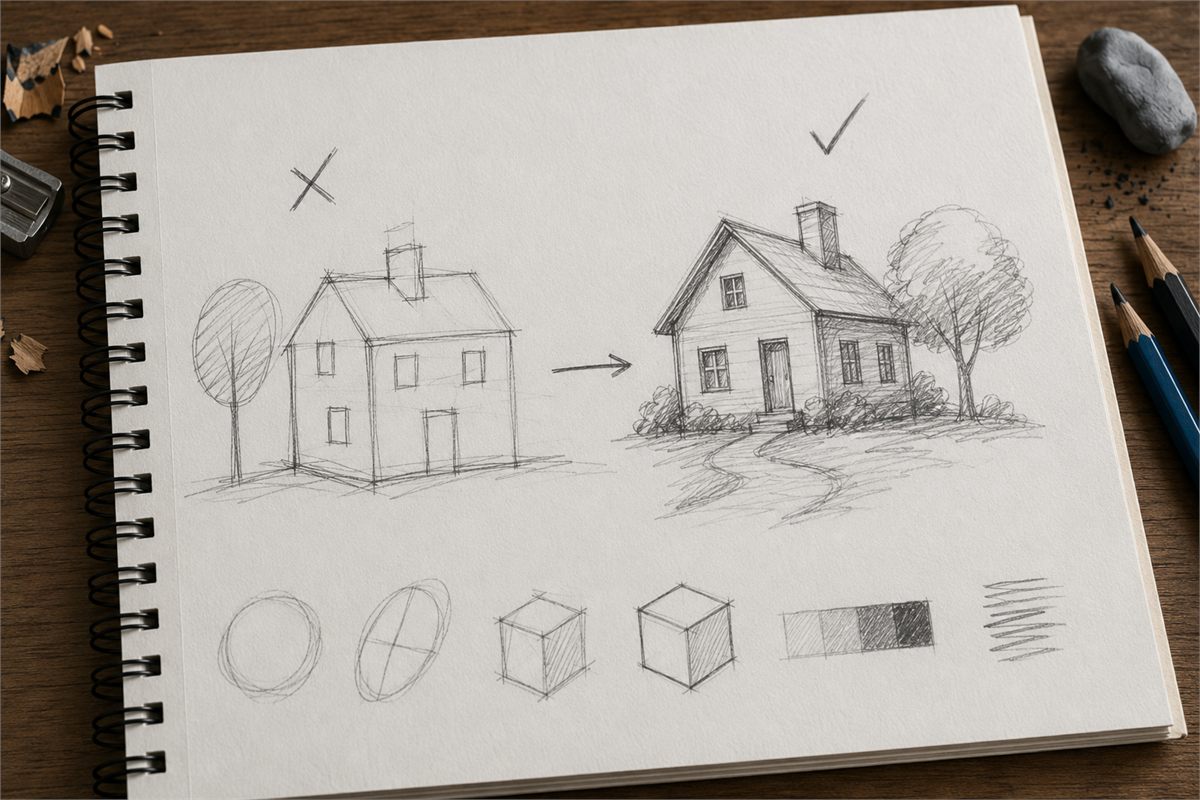
Ask an adult to draw an eye. I bet that most people will draw the symbol for an eye: the almond shape with a circle in the center. That is not what an eye looks like. That is how you draw an eye, not what an eye is. Houses get five windows in a row. Faces get eyelashes like fence posts. That is symbol drawing, and it is usually a sign that you are drawing the symbol for something rather than the thing itself.
The fix: draw things you have no symbol for. Draw crumpled up pieces of paper, a bell pepper, your non-dominant hand, something drawn upside down. Look at their actual edges, angles and spaces rather than reaching for a familiar symbol. That makes observation part of the exercise.
Reason 7: You have no feedback loop (the reason behind the reasons)
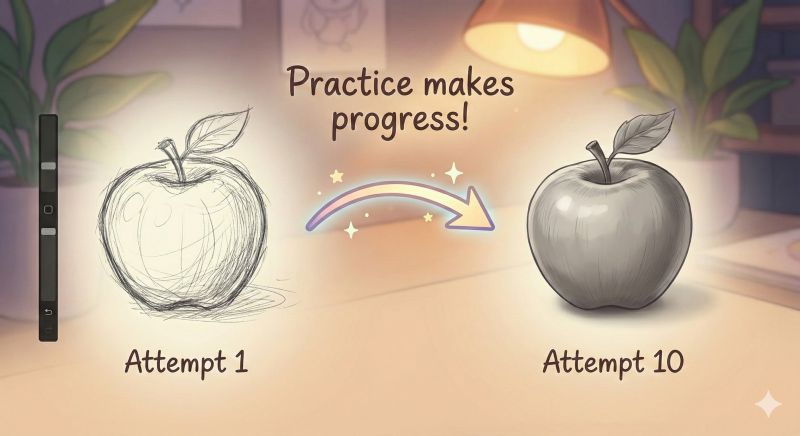
Here’s the meta-problem: each of these potential causes is easy to fix once you can identify that they are causes of your lack of progress as a draftsman — but not when you are in a state of not knowing about them. Most self-taught artists work without a feedback loop on their work, drawing again and again in slightly different ways, while failing at the same thing. That’s not to say that all practice is without value — far from it — but research into deliberate practice for drawing reveals that without specific feedback on particular aspects of technique, most people simply reinforce their current bad habits.
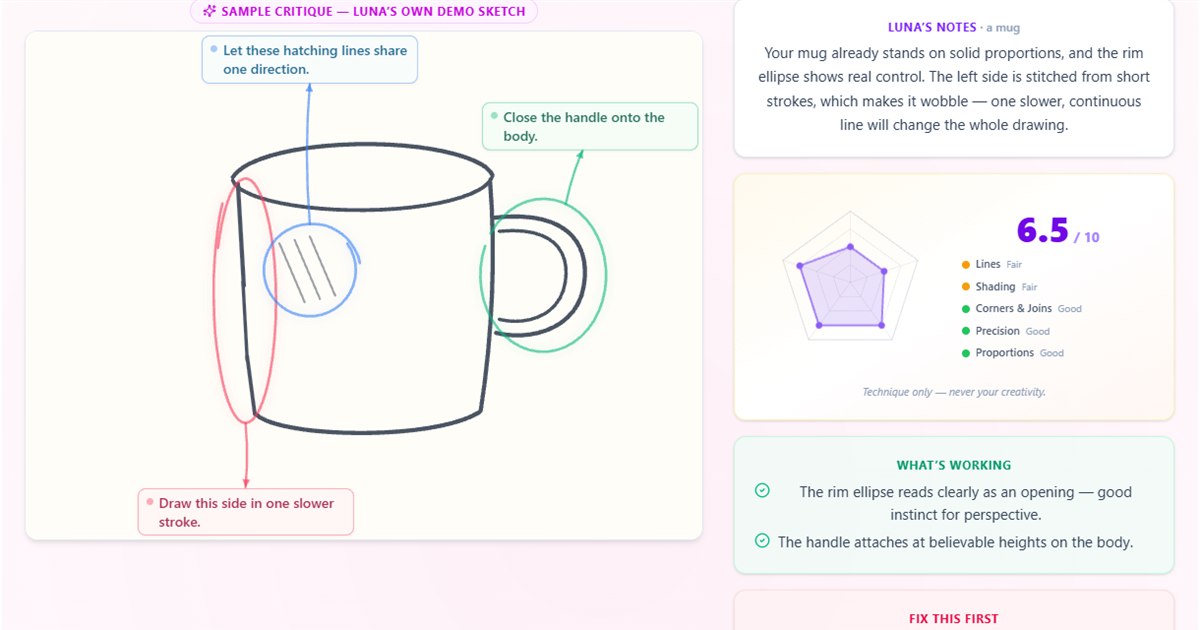
The fix: close the loop. This can mean posting your latest drawings to your online criticism community or asking for feedback from an artist friend. You can also get a free sketch critique – five technique scores with notes circled directly on your drawing. This way, “something is off” becomes “this join, this line, these values.”
How to find out which reason is yours
Put your latest drawing in front of you and ask these five questions honestly and in the order listed:
- Lines: Are my long lines single confident strokes, or stitched segments?
- Proportions: If I mirror the drawing, does anything jump out as skewed?
- Values: Is there a true dark and a true light in your sketch or are they merely mid-tones?
- Joins: Do my corners actually close, or do they overshoot or leave a gap?
- Precision: Did the marks go exactly where you wanted them to?
The question that made you wince becomes your answer for the two weeks you focus on one skill, ten minutes a day. This is how art teachers give a critique: describe, analyze, don’t judge creative merit.
Or get AI feedback on your drawing
This is what our free critique tool looks like. We built it for exactly this purpose – we want to help you, to check your work and never draw for you, to score the 5 skills for you and circle the spots on your drawing where you need to improve and even give you one fix for your drawing and a 5-minute exercise to practice your weakest skill.
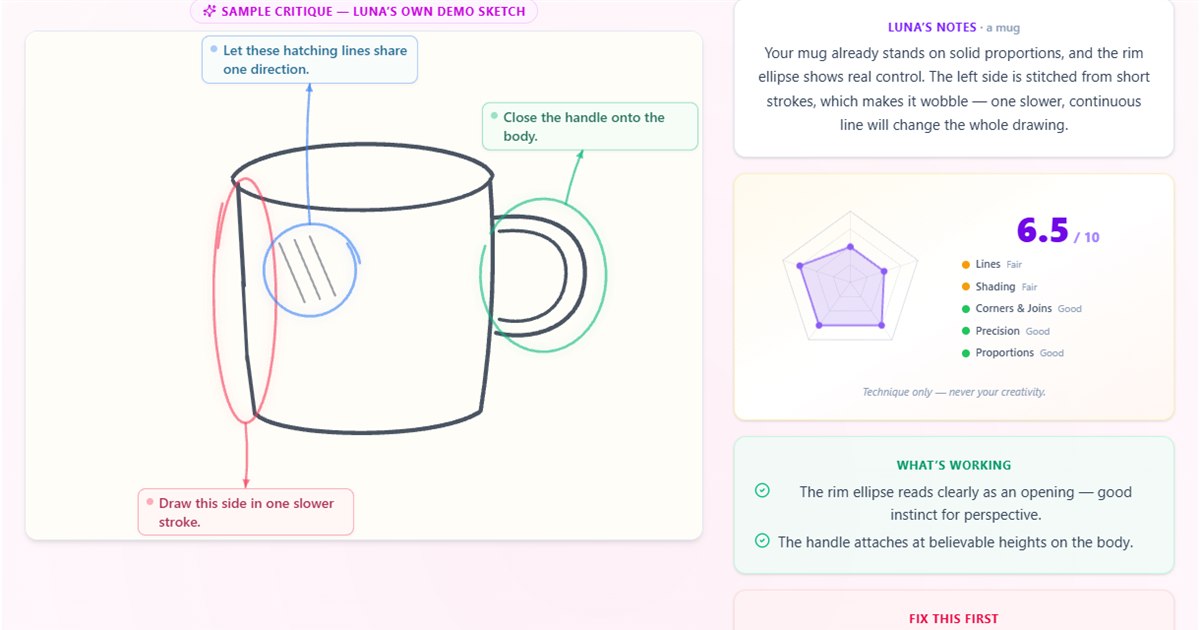
Use the feedback to improve your own drawings. Look for one useful comment and compare it with your drawing. Practice that part and then draw again.
Find out what's holding your drawings back
This is what a free critique of your sketches looks like. It gets checked by AI, so compare the advice with your own drawing. It gets 5 scores and there are notes written directly on your drawing as well as a fix and a 5min exercise that you can apply to your next drawing.
Rate my sketch — free
Tomislav Lombarovic
The Founder of Drawize Academy. Originally creator of the Drawize game, a simple online game which has served over 10 million players.