
Most importantly, it is very hard to look at your own work objectively for the same errors you created in the first place. A fresh look or a measurement can help. Try 5 free drills that check specific drawing relationships and show where your estimates drift.
This is familiar territory. Every artist has had the experience of finishing a drawing and knowing instantly that it is terrible. But not being able to put your finger on why. So you stare at it, flip it over to look at it backwards, finally filing it away to be re-visited in a week or so. And then instantly you know what’s wrong with it: the head is too big.
You do not always need to wait a week for a fresh look. We’ll explore a few ways to check your drawing while you are still working on it.
The same judgment that created the error is the judgment to be checked.
When drawing a line, we don’t measure it. Rather, we make a fast and often accurate estimate for how long something will be. We use this same sort of internal ‘guesstimate’ for just about everything in our drawings, and it’s generally very close to correct.
However, when we come to check our drawing, we use the same estimator. So, if our sense of “halfway” is off by a few percent when we place our marks, it may be off in the same direction when we check our drawing. Thus the error can be hard to notice from within the drawing process.
The classic methods to check your drawings give you different ways to reconsider those estimates. So, flipping your drawing over, turning it up side down, viewing it in a mirror, squinting at your drawing, leaving it for a week or so — all of these methods can help you re-estimate relationships that you originally estimated.
Check a few basic relationships before adding more detail.
The second useful thing about error on drawing is that it tends to repeat itself. There are a few issues with relationships that account for most of the error and these are mostly boring. A misplaced form is not corrected by adding more detail to it. Getting an eye of high quality in the wrong place looks far worse than a quite poor eye in roughly the right position.
Some of these are so consistent that you can predict them before somebody draws them:
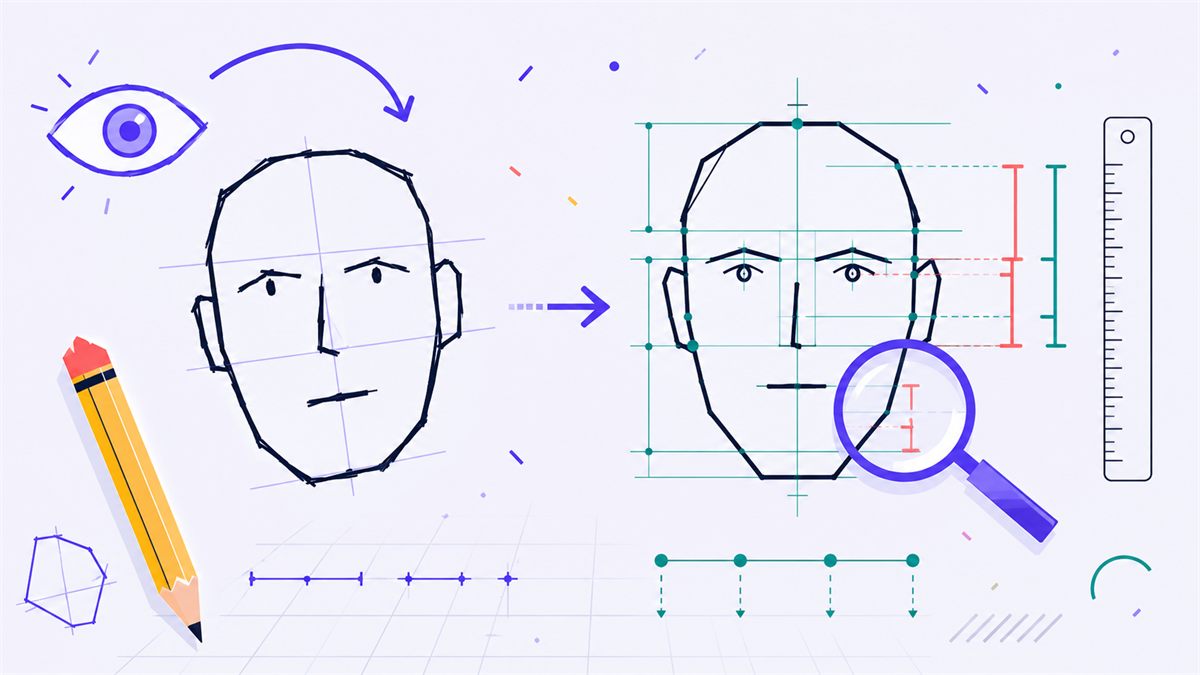
- The eyes sit roughly halfway down a level adult head. The eye line is often near the halfway point from crown to chin — not a third of the way down. This is a starting guide, not a rule for every face or head angle. Check the space above the eyes as well as the features below them.
- There is often about an eye-width between the eyes. In a simplified front-view adult head, the five-eye-width guide is: side space, eye, gap, eye, side space. Compare the actual face before using it. The gap is easy to overlook when you draw features separately rather than placing them within a head.
- Vertical and horizontal distances can read differently. Mark the middle of an upright line and a horizontal line, then measure both. Your own results will tell you whether your estimates miss in a consistent direction.
- A wobbly line is usually the result of you drawing it too slowly. Very slow drawing can lead to repeated small corrections along a line. Try planning the path and using a comfortable, continuous motion. There is no universal one-second cutoff, and speed is not the only possible cause of wobble.
Every one of those is a number. A number is the one thing your own estimator cannot quietly overrule.
So we built the outside opinion
We have been working on a set of drawing drills for the last while. Alongside scores for the measured task, these drills will tell you specifically what went wrong and how to fix it. We have made sure that these are free, unlimited, and that you can get instant feedback on your drawing. We have tried to keep the arithmetic required to analyze your drawing on the client, which is why we can afford to let you use these as much as you like.
- Freehand circles — where your arc flattens, in clock positions, and whether you traced it rather than drew it.
- Drawing straight lines – Differentiating between a smooth bow shape (an aiming problem) and a wobbly line (a speed problem). Note that straight lines look very similar to each other when only measuring for accuracy, and thus need very different fixes.
- Ellipses in a plane — whether the degree matches the surface it sits on (the most common error with wheel, cup, bottle openings etc.).
- Divide by eye - This measuring tool tests the estimator. You're given 6 bars of varying height and you have to mark the middle of each one. It then lets you know if your misses are all headed in the same direction and if you're reading the upright lines differently from the flat ones.
- A cylinder in perspective. Your end ellipse looks perfect on its own but not when attached to a form. In the drawing test, we tell you in degrees how far off-axis your end-ellipses are.
Need a single test that samples several drawing skills? The drawing test measures a selection of drawing fundamentals in a matter of minutes and gives you a profile of your skills with the weakest skill listed and provides you with specific drills to help you improve. No signup is required and your scores are never held back from you.
What a Measurement Can and Cannot Do for You
It is worth being clear about the limits of any tool that you are going to use to measure drawing. There is nothing worse than a tool that over sells itself and eventually gets discounted by users.
Measuring a stroke will not tell you how well you drew a hand. It might tell you that a circle is 14% wider than it is tall and that its flattened arc is between 7 and 9 o’clock. That does not necessarily mean that your drawing of hands looks like hands. There are plenty of good drawings of hands that contain many shaky circles. If you want to know about the proportions of what you have drawn to your reference image, the shading and all the other factors that will help you to know how to improve your drawing then you need to look at Rate My Sketch.
We provided the entire method for how we measure drawing in How We Measure Drawing for Skill. This was in part because a tool claiming to measure drawing should be checkable. Most of all, however, because a number that one cannot interrogate is, in the end, mere opinion. We were attempting to get at an opinion one wouldn’t have already.
The practical version, if you skipped to the end…
It is very hard to test your own skill. Flip the page, turn it upside down, or even measure with a ruler to get around this. Then check the relationships between things in the scene before adding more detail. This is where your drawings fail the most. The most valuable thing that a drill can tell you about your own eye is something that you wouldn’t have figured out by working harder at drawing.

Tomislav Lombarovic
The Founder of Drawize Academy. Originally creator of the Drawize game, a simple online game which has served over 10 million players.